Case study
Offline-first field operations app for construction and marine workflows
Android work on a multi-brand field operations product where offline reliability, data safety, visual workflows, and practical delivery mattered more than polished demo scenarios.
My role
Main Android developer responsible for implementation, client communication, task breakdown, demos, onboarding other developers, and maintaining the Android architecture.
Core challenge
Making sure users could keep working in poor network conditions without losing forms, photos, reports, annotations, task updates, chat, requests for information, or scopes of work.
Product context
A multi-brand Android application used by project managers, contributors, suppliers, clients, and field teams across construction and marine-related workflows.
Context
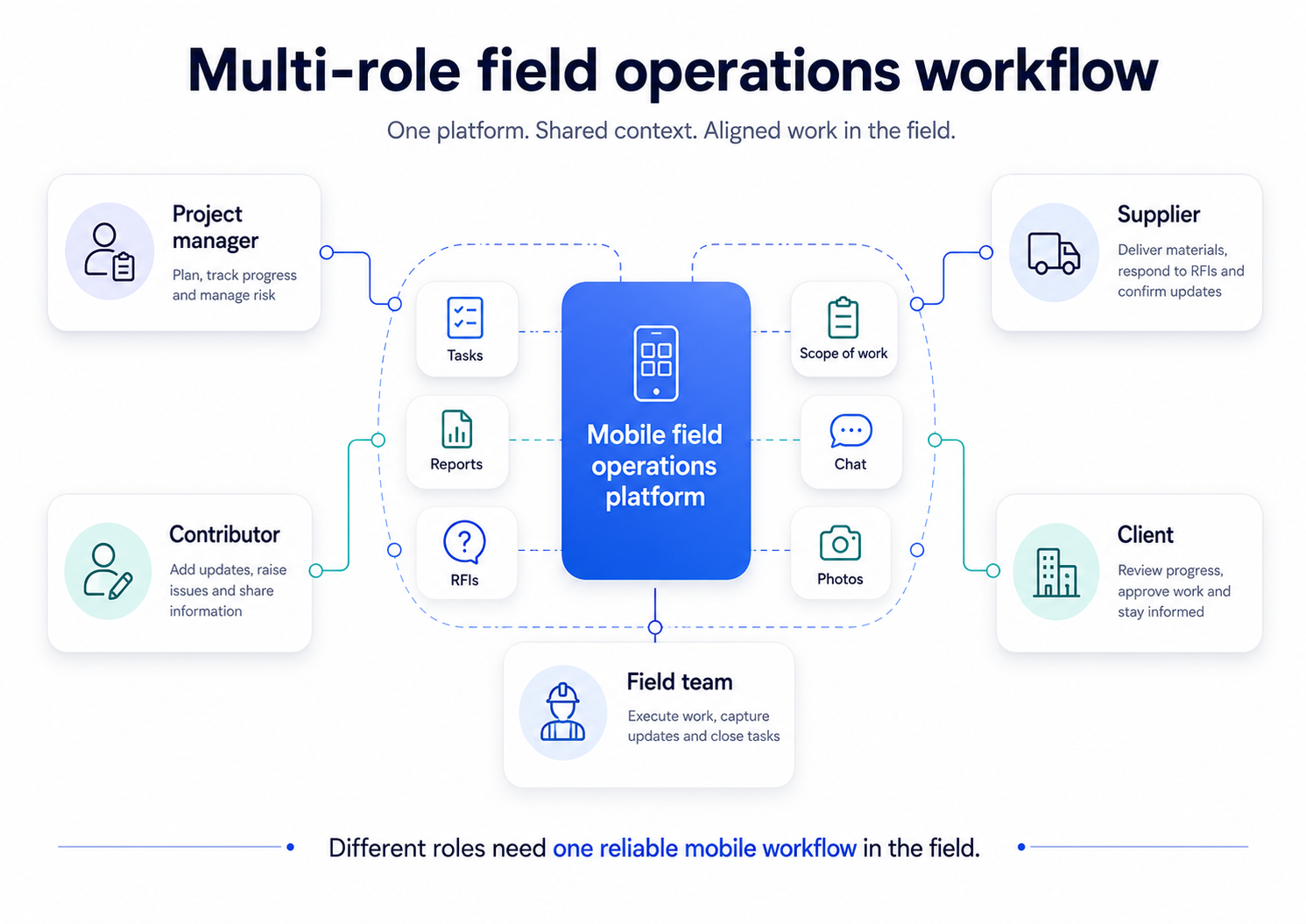
I worked on a multi-brand Android application used in construction and marine-related field operations. The product supported different user roles, including project managers, contributors, suppliers, clients, and field teams.
The app was not just a mobile UI on top of a backend. It was a product-critical tool used in environments where network quality could be poor, data could be collected on-site, and users needed confidence that their work would not disappear.
Multi-role field operations
The product supported multiple roles working around the same field data: project managers, contributors, suppliers, clients, and field teams. A key part of the mobile experience was keeping their work aligned in one shared operational context.
The challenge
The hardest part was reliability in real field conditions.
Users needed to create and update forms, upload photos, manage reports, work with tasks, chat, request information, handle scopes of work, annotate visual materials, and synchronize everything safely with the backend.
The app had to keep user data safe even when connectivity was unstable. Losing field data, photos, reports, annotations, or task updates was not acceptable.
What I worked on
Offline-first architecture
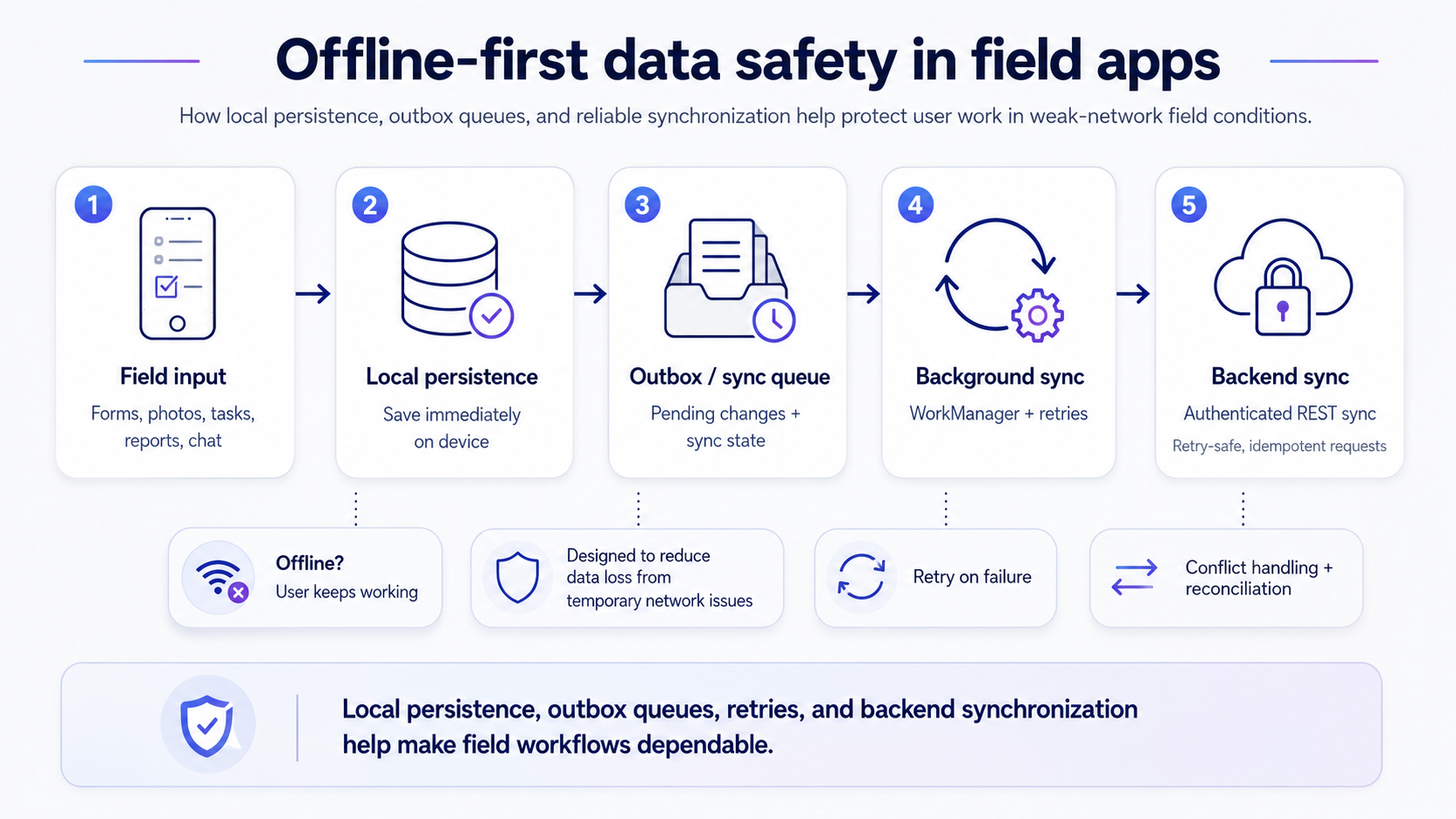
Local-first forms, sync queues, retries, conflict handling, outbox-style flows, Room-based storage, and WorkManager background jobs.
Data safety
Making field data recoverable and safe under unstable network conditions, especially for forms, reports, photos, tasks, chat, and annotations.
Visual workflows
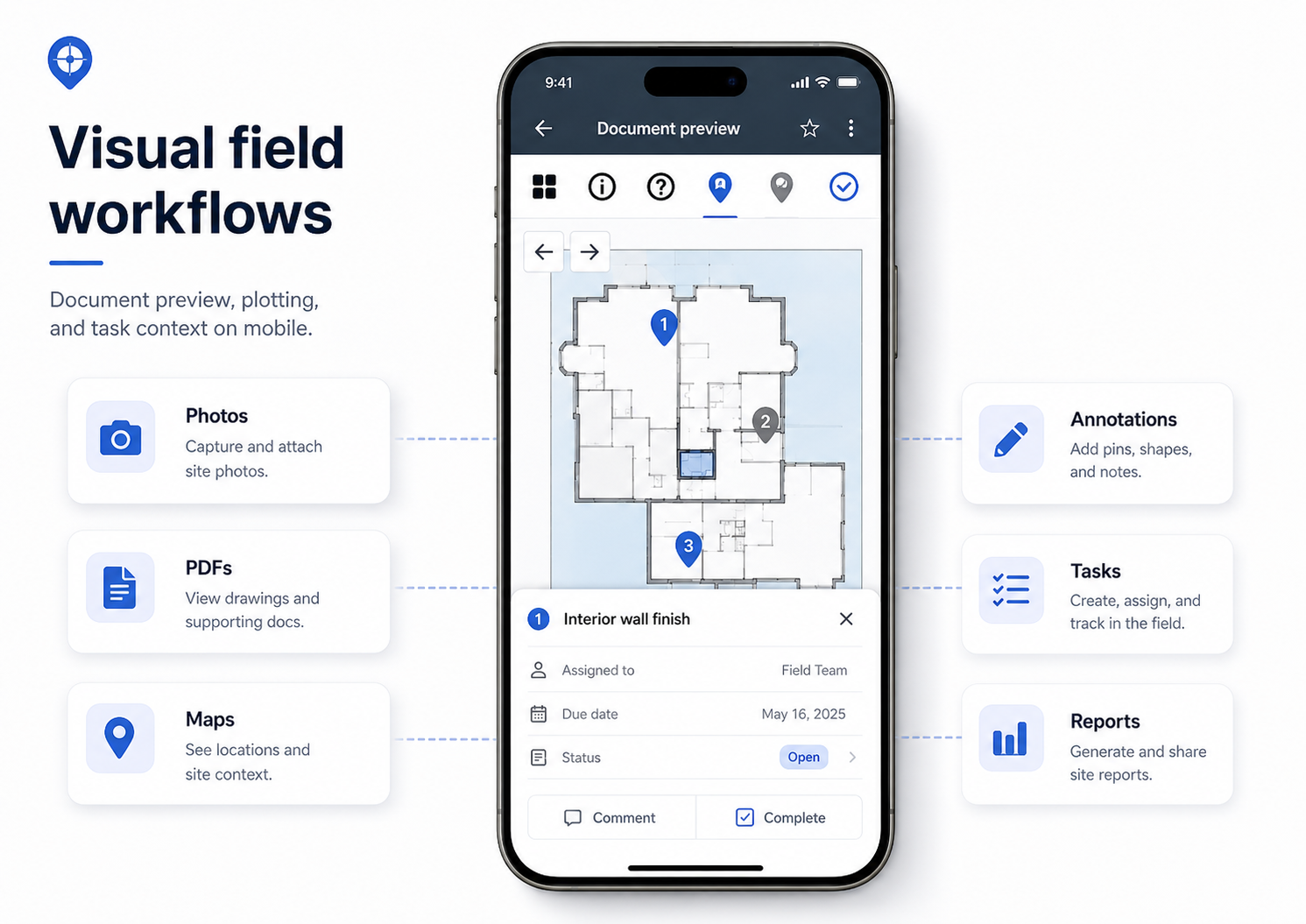
Plotting and annotation on photos, PDFs, maps, and documents, plus multi-photo upload and handling of large visual assets.
Delivery ownership
Client communication, task breakdown, demos, onboarding other developers, and keeping the Android architecture maintainable.
Visual field workflows
A major part of the product involved visual workflows: opening construction documents and models, plotting issues on visual assets, attaching context, and helping users work with field data directly on mobile devices.
Technical approach
The key architectural decision was to treat local data as a first-class part of the product, not just a temporary cache.
That meant designing flows where work could be created locally, saved safely, retried, synchronized later, and recovered when network conditions were unreliable. The system needed to balance data safety, delivery speed, feature complexity, and maintainability.
The goal was not to build an abstract offline framework. The goal was to make real field workflows dependable.
Offline-first data safety
In field operations, the most important mobile requirement is not just a polished UI. Users need confidence that forms, photos, reports, tasks, chat messages, annotations, and other work will not be lost when connectivity is weak or unavailable.
Impact
The work improved confidence in using the app in real-world field conditions, where users could not assume stable connectivity. It also helped the Android codebase support complex workflows more predictably, while making it easier to onboard other developers and continue delivery.
Tech stack
Interested in similar work?
Let’s talk
I am open to senior Android / Kotlin roles, B2B contracts, architecture support, and product-focused mobile consulting.